
Speed Humps in Brisbane?
 Printer-friendly version
While Brisbane is miles from the dense traffic challenges of downtown San Francisco, we do experience our own unique traffic issues. At times, residents feel that speeding is an issue on certain streets in town and then ask, “Why can’t I get a speed hump installed on my street?” Speed humps are raised sections of pavement or rubber that are placed mid-block and are designed to slow vehicles on residential streets. According to the Institute of Transportation Engineers (ITE), they typically range from 12 to 14 feet in travel length and are about three inches in height. Speed humps were introduced in the U.K. in the 1980s and were adopted by multiple U.S. municipalities as a popular traffic calming measure.
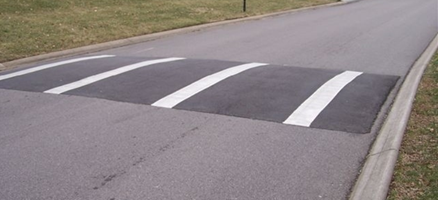
Unfortunately, speed humps have unintended consequences. They cause an increase in noise from vehicle acceleration, braking, and suspension rattling, affecting those who live near them. Based on general engineering practice, speed humps are not installed on steep streets with grades greater than five percent (5%) because they can gather water, creating unsafe braking conditions. In addition, speed humps are rough on automobile suspensions and drivers’ backsides when they are driven over on a regular basis. Perhaps most seriously, speed humps impact emergency vehicle response. According to the ITE, speed humps can cause up to a ten-second delay for an ambulance with a patient.
Because of the unintended consequences and resulting backlash from the public, some cities have had to recover from installing too many speed humps. For example, the City of Berkeley installed over 150 speed humps in the early 1990s. After their placement, the Berkeley Fire Department claimed that these devices caused damage to fire trucks and led to significantly longer response times. Residents with disabilities stated that the rough motion when driving over speed humps, even at very low speeds, caused serious pain and discomfort. These concerns led the City to impose a moratorium on the installation of speed humps in 1995 while it explored other traffic calming measures.
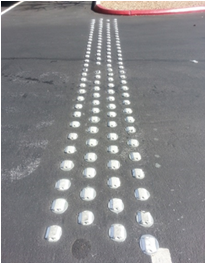
The traffic calming “toolbox” has grown over the years, and there are other effective alternatives to speed humps that have less physical impact on moving vehicles. Dragon’s teeth, a method widely adopted in the U.K., are teeth-shaped pavement markings that slow drivers through psychological measures. “Botts dots” are small ceramic bumps that are primarily used as lane dividers, but can be arranged into rectangular rumble strips that create a vibrating sensation. Traffic calming measures such as these are being widely implemented in municipalities to address speeding issues.
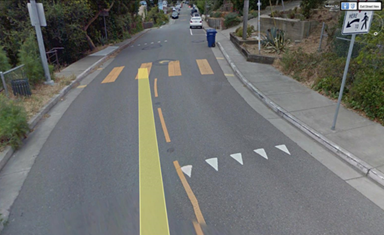
Left: Dragon’s teeth markings on Solano Street in Brisbane. Photo courtesy of Google Earth.
Right: Botts dots. Photo courtesy of http://www.paverpatch.com/traffic-calming-devices/
If you have concerns regarding speeding on your street, please contact Public Works. Staff will observe the location in question, and if necessary, will conduct a more thorough technical investigation, possibly including 24-hour speed surveys, to determine if a hazard that can be corrected through engineering techniques is present.
Please make an effort to slow down and to be mindful of bicyclists and pedestrians. Enjoy the beauty of your home while driving safely!
For any questions or concerns regarding speed humps, please contact Deputy Director of Public Works Karen Kinser at 415.508.2130 or kkinser@ci.brisbane.ca.us.