SJohnson
Appendix
3
Scenario
3
-
Dissolved
Phase
Benzene
Concentrations
Only
in
Groundwater
(Low
concentration
groundwater
scenarios
with
or
without
Ci
measurements)
Defining
the
Bioattenuation
Zone
Without
Oxygen
Measurements
or
Oxygen
<4%
Existing
Building
o
r
Future
Construction
No
0
2
data
or
<4%
TPH
<
100
mg/kg
Benzene
<
100
ug/L
[=6gure
A
Benzene
<
1000
ug/l
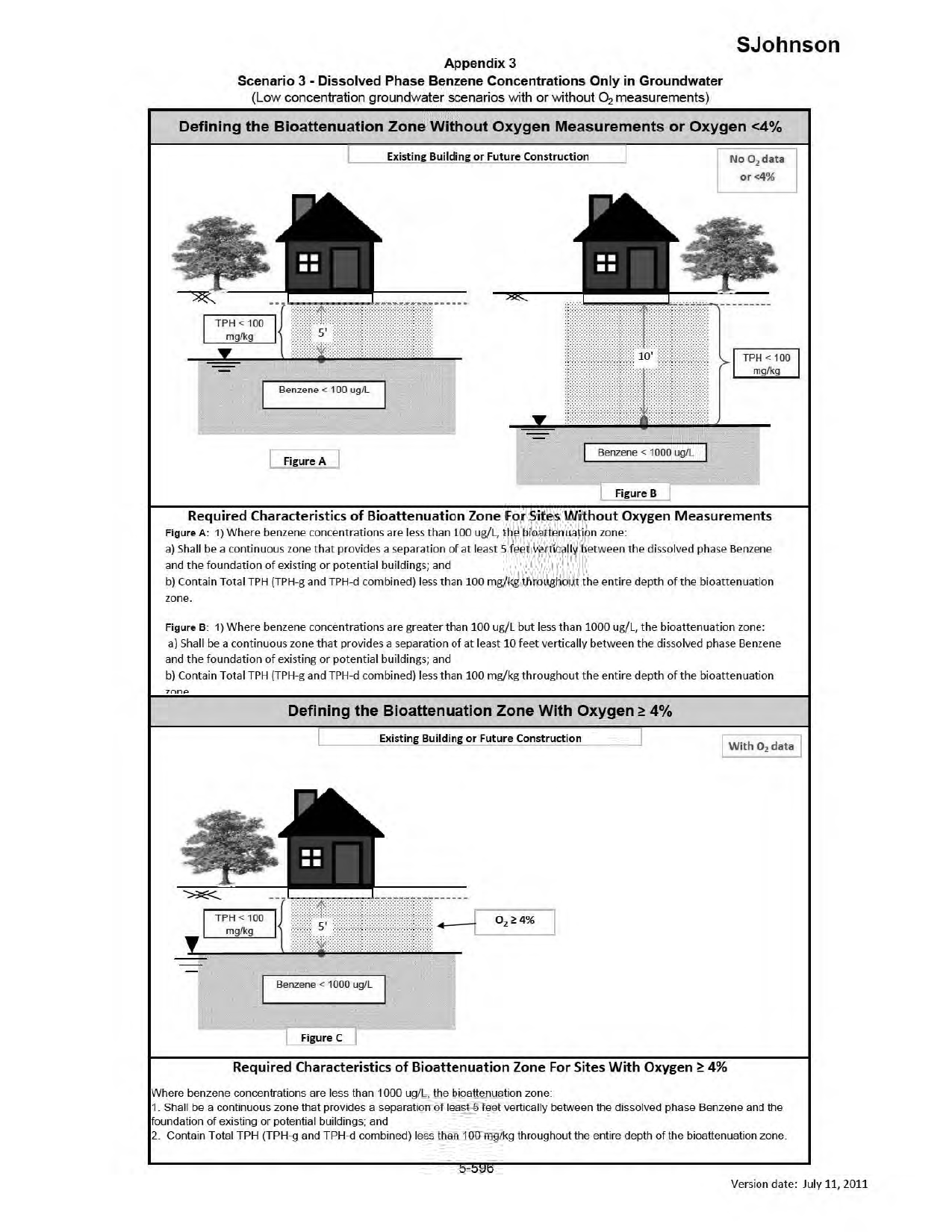
Required
Characteristics
of
Bioattenuation
Zone
For
Sites
Without
Oxygen
Measurement
s
Figure
A
:
1)
Where
benzene
concentr
ations
are
less
than
100
ug/L,
t
he
bioattenuat
ion
zone:
a)
Shall
be
a
conti
nuous
zone
t
hat
provides
a
separat
ion
of
at
least
S
feet
vertically
between
the
dissolved
phase
Benzene
and
t
he
foundation
of
existing
or
potential
buildings;
and
b)
Contain
Total
TPH
(TPH-g
and
TPH-d
combined)
less
t
han
100
mg/kg
t
hroughout
t
he
entire
depth
of
the
bioattenuation
zone.
Figure
B:
1)
Where
benzene
concentr
ations
are
greaterthan
100
ug/L
but
less
than
1000
ug/L,
the
bioatt
enuation
zone:
a)
Shall
be
a
continuous
zone
that
provides
a
separat
ion
of
at
least
10
feet
vertically
between
the
dissolved
phase
Benzene
and
the
foundation
of
existing
o
r
potent
ial
buildings;
and
b)
Contain
Total
TPH
(TPH-g
and
TPH-d
combined)
less
t
han
100
mg/kg
t
hroughout
t
he
ent
ire
depth
of
the
bioattenuation
Defining
the
Bioattenuation
Zone
With
Oxygen
~
4%
Exist
ing
Building
or
Fut
ure
Construction
I
With
0
2
data
I
Benzene
<
1000
ug/L
Figure
C
Required
Characteristics
of
Bioattenuatio
n
Zone
For
Sites
With
Oxygen
~
4%
Where
benzene
concentrations
a
re
less
than
1000
ug/L,
the
bioattenuation
zone
:
1.
Shall
be
a
continuous
zone
that
provides
a
separation
of
least
5
feet
vertically
between
the
dissolved
phase
Benzene
and
the
foundation
of
existing
or
potential
buildings;
and
2.
Contain
Total
TPH
(TPH-g
and
TPH--0
combined)
less
than
100
mg/kg
throughout
the
entire
depth
of
the
bioattenuation
zone.
Version
dat
e:
July
11,
2011