OSEC
Open
Space
&
Ecology
CEQA
Comments
on
Brisbane
Baylands
Draft
EIR
-
2013
Measure
4P-2b
requires
LED
based
lighting.
It
would
be
better
to
require
the
most
efficient
lighting
appliances
in
use
at
the
time
of
project
approval.
Measure
4P-2c
specifies
a
certain
number
of
megawatt
hours
of
renewable
energy
generation.
This
measure
should
be
restated
to
require
renewable
energy
generation
in
amounts
that
take
into
account
future
technological
improvements.
Page
4.P-3.
15
Page
3
pl
states
1,784.6
MWh
of
electricity
are
used
annuaJly
on
the
project
site.
pg
15
p5
states
the
existing
electrical
consumption
within
the
project
site
is
8,084.6
MWhs.
It
is
unclear
that
one
value
is
exclusive
for
Recology
and
the
other
value
is
the
total
for
the
project
site.
This
should
be
made
clearer
to
understand.
General
comments
on
section
4.P:
1.
If
Recology
is
willing
to
pursue
a
renewable
energy
program
beyond
their
requirements,
can
we
or
can
we
not
expect
the
development
plans
to
also
do
this?
2.
At
various
points
in
the
Energy
Resources
section,
it
cites
various
metrics
used.
Title
24
Standard,
targets
established
in
S-14-08
and
S-21-09,
Assembly
bill
1007,
etc.
This
chapter
becomes
very
confusing.
A
chart
is
needed
to
show
what
standards
are
being
applied
to
which
Project
Impacts
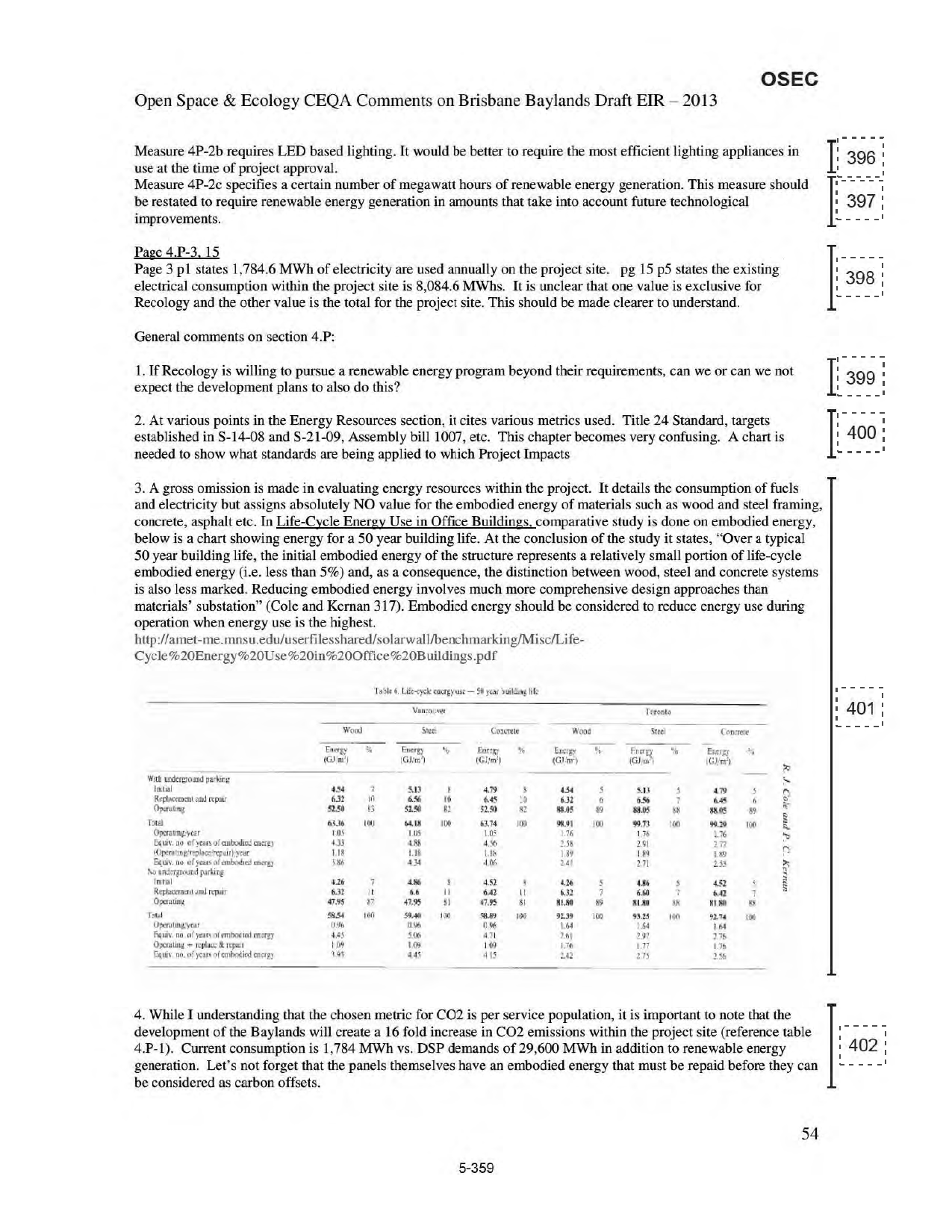
3.
A
gross
omission
is
made
in
evaluating
energy
resources
within
the
project.
It
details
the
consumption
of
fuels
and
electricity
but
assigns
absolutely
NO
value
for
the
embodied
energy
of
materials
such
as
wood
and
steel
framing,
concrete,
asphalt
etc.
In
Life-Cycle
Energy
Use
in
Office
Buildings.
comparative
study
is
done
on
embodied
energy,
below
is
a
chart
showing
energy
for
a
50
year
building
life.
At
the
conclusion
of
the
study
it
states,
"Over
a
typical
50
year
building
life,
the
initial
embodied
energy
of
the
structure
represents
a
relatively
small
portion
of
life-cycle
embodied
energy
(i.e.
less
than
5%)
and,
as
a
consequence,
the
distinction
between
wood,
steel
and
concrete
systems
is
also
less
marked.
Reducing
embodied
energy
involves
much
more
comprehensive
design
approaches
than
materials'
substation"
(Cole
and
Kernan
317).
Embodied
energy
should
be
considered
to
reduce
energy
use
during
operation
when
energy
use
is
the
highest.
http://amet-me.mnsu.edu/userfilesshared/solarwall/benchmarking/Misc/Life-
Cycle%20Energy%20Use%20in%200ffice%20Buildings.pdf
la
bk
6.
Li!"c-c}..::k
cw.·rt;y
us~
-
V1n:o1:.~
~O
)CJf
':'lu.ildrng
life
I
I
I
I
I
f('lroolo
C::OJCT<k
W~d
(('IX'ft\('
Wood
E11~r~·
5tCC:
\;
S!tel
iGJlnt'J
Witti
undcryouM
par\1q;
(CiJtn:i'J
S.
IJ
1,1
6.56
E""!Y
'>
I
10
ll
1
00
£o<rgy
!Cl:m
1
)
~·
:o
~l
EJltf~)
(GJ:m')
"
F.rerfO'
(GJ,m)
'I',
/~~~!,
6.•s
4.7'
1.
lllilial
lleplacrm:at
,Uld
ct"patr
Op<n1'"i
Tml
Oj.>.-ra~nf/)<ar
Eq1m·
00
cr~eanofanbodicdcn:r!}'
..
.s
..
6J2
~Ba
~.J~
~.!9
1;
IQIJ
us
52-5'J
8
•
.5-j
S.IJ
6
;
J
6Jl
118~
6_
..
5
~
"'
~
~
~
il39
~18
I
05
l
Ol
113.74
1.0;
1
00
((}rtr1r1ntffrpla~'rq:i11)·~rdf
&lci\•_
uo
lm11~
1
d5a1~u!~ba~cdi=r.er111
OJ
118
H6
4.2'
6.Jl
47.95
SS.54
4.8!
I.II
4.51>
4.06
I
II
1'o
vndap~.n.md
pukir.J!
~'t"1n-.:nl.t1M.il\.-pllir
•J..I
1
ll
3>
100
4.M
41.,,
5'"'41
w
9UI
1.76
2.li
,
.~
19
JOO
88.l>S
99.TJ
1
i~
ii
100
2
~1
l
l"l
!IS.OS
99.29
!.76
2.72
l.&9
89
100
~
:-.
:i
~
2.•I
!
II
~I
211
5
7
•
.U
6.~
Bl
4.Sl
6Al
47.~
~
Opi!t'
.1.ti.t1
1,
,
.,
...
1
••
•
•.l,
..
Jl
SI.Ill
'2.3'
!I
EIO
S9
IDD
!l.8G
Ul~
!S
l()(o
~I
.II/I
uz
2
.1~
4.Sl
j
~
7
§
~
100
0,...Jlll\J;)M
F.:im,,
no
ofyunoll'lflbOOio:ICT..:rp
Open
ting
-
><pl...<
.l
~ql!IV
no.
of)tu'
of
cmbc..Uol
<rC!'$)'
''I'"''
0%
4.'-5
l
09
O.W>
Htl
1.00
4
41
0%
411
I
OY
1.6-1
l.1>4
2.97
'l.74
I
64
100
'M
l42
l.•6
'91
4
IS
1.11
l7l
1.76
H6
4.
While
I
understanding
that
the
chosen
metric
for
C02
is
per
service
population,
it
is
important
to
note
that
the
development
of
the
Baylands
will
create
a
16
fold
increase
in
C02
emissions
within
the
project
site
(reference
table
4.P-1).
Current
consumption
is
1,784
MWb
vs.
DSP
demands
of
29,600
MWh
in
addition
to
renewable
energy
generation.
Let's
not
forget
that
the
panels
themselves
have
an
embodied
energy
that
must
be
repaid
before
they
can
be
considered
as
carbon
offsets.
I
54
5-359