CPA2
4
Windsurfing
Sen
sitivity
to
D
evelopme
nt
The
reality
is
that
very
few
outdoor
recreational
activities
are
so
impacted
by
human
development
than
near-
shore
wind-oriented
activities.
Windsurfing
is
incredibly
sensitive
to
environmental
conditions
and
suffers
immensely
from
an
increase
in
turbulence,
the
introduction
of
wind
shadows,
and
reduction
in
mean
speeds.
4.1
Sp
ecial
Risk
to
Off-S
hor
e
Wind
Sites
Many
instances
of
upwind
development
have
damaged
or
rendered
downwind
activities
unusable
in
off-shore
wind
locations.
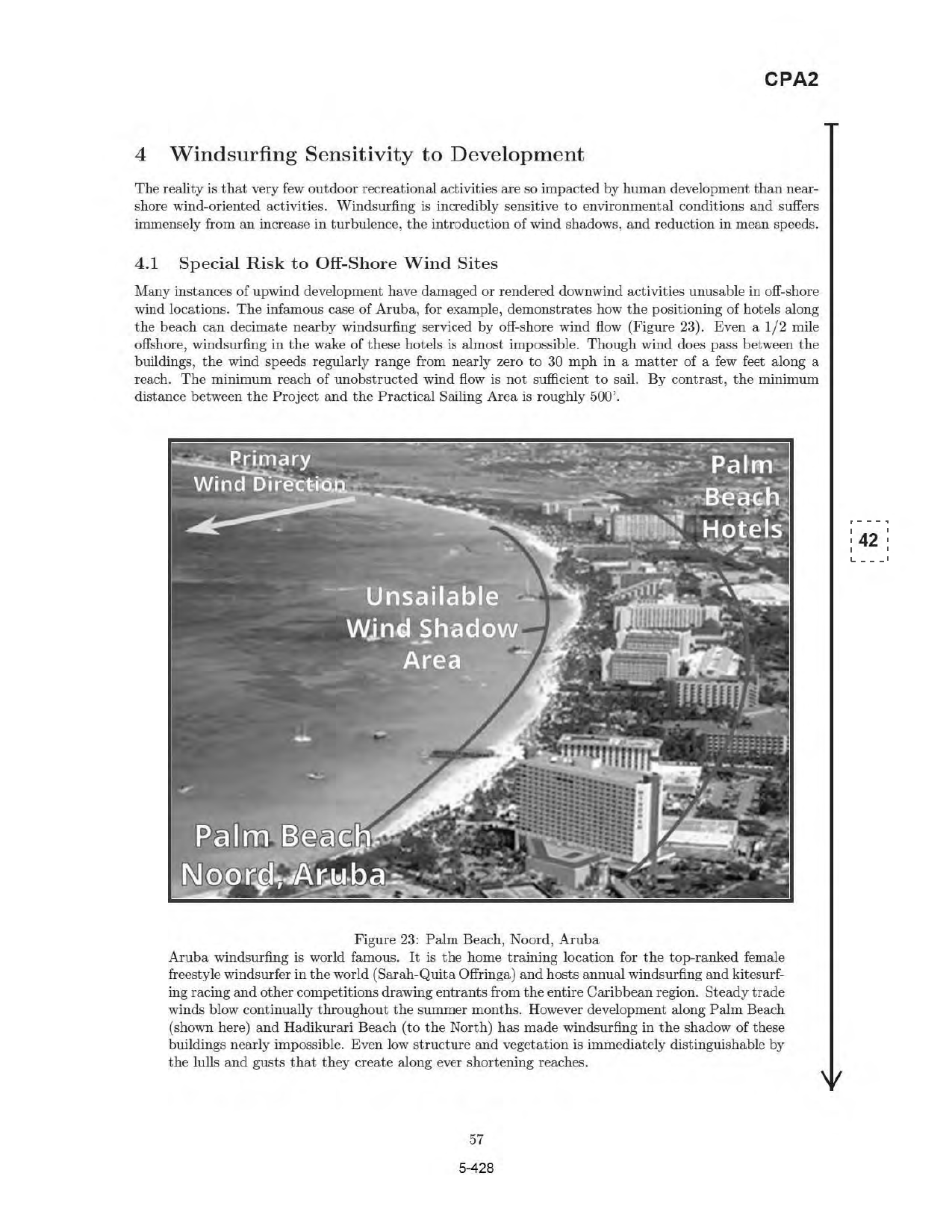
The
infamous
case
of
Aruba,
for
example,
demonstrates
how
t
he
positioning
of
hotels
along
the
beach
can
decimate
nearby
windsurfing
serviced
by
off-shore
wind
flow
(Figure
23)
.
Even
a
1/
2
mile
offshore,
windsurfing
in
the
wake
of
these
hotels
is
almost
impossible.
T
hough
wind
does
pass
between
t
he
buildings,
the
wind
speeds
regularly
range
from
nearly
zero
to
30
mph
in
a
matter
of
a
few
feet
along
a
reach.
The
minimum
reach
of
unobstructed
wind
flow
is
not
sufficient
to
sail.
By
contrast,
t
he
minimum
distance
between
the
P
roject
and
the
P
ractical
Sailing
Area
is
roughly
500'.
Figure
23:
Palm
Beach,
Noord,
Aruba
Aruba
windsurfing
is
world
famous.
It
is
the
home
training
location
for
the
top-ranked
female
freestyle
windsurfer
in
the
world
(Sarah-Quita
Offringa)
and
hosts
annual
windsurfing
and
kitesurf-
ing
racing
and
other
competitions
drawing
entrants
from
the
entire
Caribbean
region.
Steady
trade
winds
blow
continually
throughout
the
summer
months.
However
development
along
Palm
Beach
(shown
here)
and
Hadikurari
Beach
(to
the
North)
has
made
windsurfing
in
the
shadow
of
these
buildings
nearly
impossible.
Even
low
structure
and
vegetation
is
immediately
distinguishable
by
the
lulls
and
gusts
t
hat
they
create
along
ever
shortening
reaches.
57
5-428