CPA2
METHODOLOGY
AND
ASSUMPTION
DEFICIENCIES
30
LEGEND
RESIDENTIAL
Flats
(Hogh
Density)
-
125'
"'••
>f•.ght
Flats
(Medium
Dens1ty)
10·
"'"
Htlglu
Townhomes
(High
OenS1ty)
Townhomes
(Medium
Density)
COMMERCIAL
-
Retail
60
Mi>
lelf'ht
Alena
150"
\
a•
H
ht
Theater
Mulbple•
12~
"'••
H,
ght
High-Rise
Office
125
Mdx
Heoghl
Mid-Rise
Office
'O"
\<••
Hoig)11
Office
R
&
0
-
1
s~·
Ma>
H••gh1
Office
R
&
0
•
2
4~'
Ma•
Height
Hotels
&
Conference
160"
M••
t~PIJ'ht
-
Ground
FIOor
Retail
Below
other
Use
INDUSTRIAL
Lrght
Industrial
-
Renewable
Energy
Generatlon(R
E
G
)
R
E
G
I
Open
Space
Reserve
WastewaterTreatmenu
Recyd•ng
INSTITUTIONAL
lnsutubOnal
Add
25'
To
Each
Max
Height
To
To
Include
Finished
Sire
Grade
Sea
Level
And
Get
Height
Above
-
·
_
__
_....i.
OPEN
SPACE
Open
Space
•
-
Developer
Sponsored
Plan
Boundary
©ii
Not
a
part
of
DSP
Entenalnment
Vanant
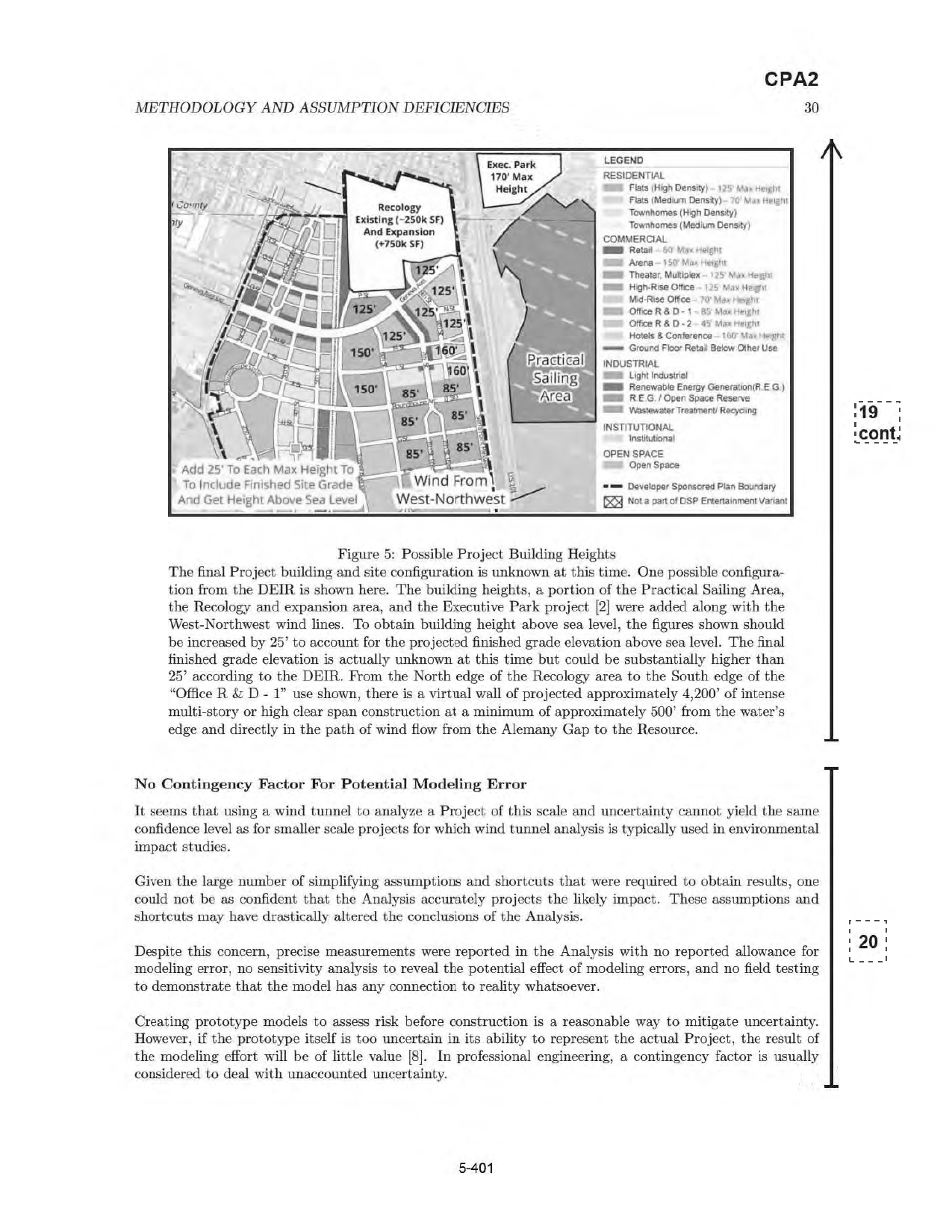
Figure
5:
Possible
Project
Building
Heights
The
final
Project
building
and
site
configmation
is
unknown
at
this
time.
One
possible
configma-
tion
from
the
DEffi
is
shown
here.
The
building
heights,
a
portion
of
the
Practical
Sailing
Area,
the
Recology
and
expansion
area,
and
the
Executive
Park
project
[2]
were
added
along
with
the
West-Northwest
wind
lines.
To
obtain
building
height
above
sea
level,
t
he
figures
shown
should
be
increased
by
25'
to
account
for
the
projected
finished
grade
elevation
above
sea
level.
The
final
finished
grade
elevation
is
actually
unknown
at
this
time
but
could
be
substantially
higher
than
25'
according
to
the
DEIR.
From
t
he
North
edge
of
the
Recology
area
to
the
South
edge
of
the
"Office
R
&
D
-
l
"
use
shown,
there
is
a
virtual
wall
of
projected
approximately
4,200'
of
intense
multi-story
or
high
clear
span
construction
at
a
minimum
of
approximately
500'
from
the
water's
edge
and
directly
in
the
path
of
wind
flow
from
the
Alemany
Gap
to
the
Resomce.
No
Contingen
cy
Factor
For
Potential
Modeling
Error
It
seems
that
using
a
wind
tunnel
to
analyze
a
Project
of
this
scale
and
uncertainty
cannot
yield
the
same
confidence
level
as
for
smaller
scale
projects
for
which
wind
tunnel
analysis
is
typically
used
in
environmental
impact
studies.
Given
the
large
number
of
simplifying
assumptions
and
shortcuts
that
were
required
to
obtain
results,
one
could
not
be
as
confident
that
the
Analysis
accurately
projects
the
likely
impact.
These
assumptions
and
shortcuts
may
have
drastically
altered
the
conclusions
of
the
Analysis.
Despite
this
concern,
precise
measm
ements
were
reported
in
the
Analysis
with
no
reported
allowance
for
modeling
error,
no
sensitivity
analysis
to
reveal
the
potential
effect
of
modeling
errors,
and
no
field
testing
to
demonstrate
that
the
model
has
any
connection
to
reality
whatsoever.
Creating
prototype
models
to
assess
risk
before
construction
is
a
reasonable
way
to
mitigate
uncertainty.
However,
if
t
he
prototype
itself
is
too
uncertain
in
its
ability
to
represent
the
actual
Project,
the
result
of
t
he
modeling
effort
will
be
of
little
value
[8].
In
professional
engineering,
a
contingency
factor
is
usually
considered
to
deal
with
unaccounted
uncertainty.
5-401