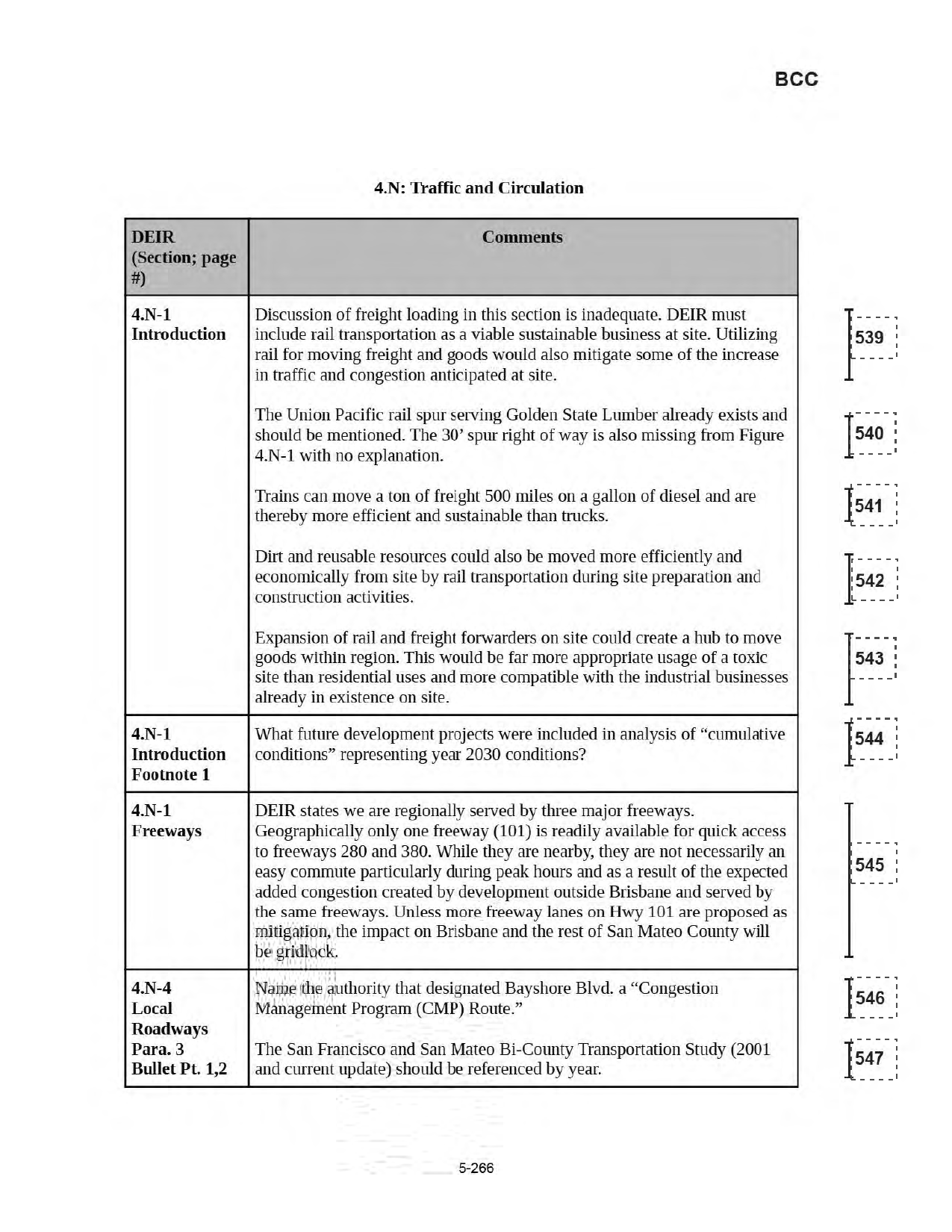
BCC
4.N:
Traffic
and
Circulation
DEIR
(Section;
page
#)
4.N-1
Introduction
Comments
Discussion
of
freight
loading
in
this
section
is
inadequate.
DEIR
must
include
rail
transportation
as
a
viable
sustainable
business
at
site.
Utilizing
rail
for
moving
freight
and
goods
would
also
mitigate
some
of
the
increase
in
traffic
and
congestion
anticipated
at
site.
The
Union
Pacific
rail
spur
serving
Golden
State
Lumber
already
exists
and
should
be
mentioned.
The
30'
spur
right
of
way
is
also
missing
from
Figure
4.N-1
with
no
explanation.
Trains
can
move
a
ton
of
freight
500
miles
on
a
gallon
of
diesel
and
are
thereby
more
efficient
and
sustainable
than
trucks.
Dirt
and
reusable
resources
could
also
be
moved
more
efficiently
and
economically
from
site
by
rail
transportation
during
site
preparation
and
construction
activities.
Expansion
of
rail
and
freight
forwarders
on
site
could
create
a
hub
to
move
goods
within
region.
This
would
be
far
more
appropriate
usage
of
a
toxic
site
than
residential
uses
and
more
compatible
with
the
industrial
businesses
already
in
existence
on
site.
1539
4.N-1
Introduction
Footnote
1
4.N-1
Freeways
What
future
development
projects
were
included
in
analysis
of
"cumulative
conditions"
representing
year
2030
conditions?
DEIR
states
we
are
regionally
served
by
three
major
freeways.
Geographically
only
one
freeway
(101)
is
readily
available
for
quick
access
to
freeways
280
and
380.
While
they
are
nearby,
they
are
not
necessarily
an
easy
commute
particularly
during
peak
hours
and
as
a
result
of
the
expected
added
congestion
created
by
development
outside
Brisbane
and
served
by
the
same
freeways.
Unless
more
freeway
lanes
on
Hwy
101
are
proposed
as
mitigation,
the
impact
on
Brisbane
and
the
rest
of
San
Mateo
County
will
be
gridlock.
Name
the
authority
that
designated
Bayshore
Blvd.
a
"Congestion
Management
Program
(CMP)
Route."
The
San
Francisco
and
San
Mateo
Bi-County
Transportation
Study
(2001
and
current
update)
should
be
referenced
by
year.
4.N-4
Local
Roadways
Para.
3
Bullet
Pt.
1,2
1546
5-266