BCC
4.C-29
Open
Space
Plan
Since
the
Brisbane
General
Plan
was
adopted
in
1994
and
the
Open
Space
Plan
was
adopted
in
2001,
the
height
and
cumulative
impacts
of
the
continuous
fill
operation
on
the
landfill
had
not
been
subject
to
any
environmental
review.
Discussions
about
current
or
2010
baseline
conditions
should
require
corrective
remediation
measures
to
reduce
those
impacts
to
the
environment.
Examples
might
be
to
dredge
the
area
east
of
101
where
the
particulate
matter
has
settled
out
or
a
requirement
to
create
new
tidal-influenced
mud
flats
within
the
project.
Another
(perhaps
interim-)
mitigation
measure
would
be
to
remove
the
invasive
weeds
and
re-landscape
with
native
plants
in
the
areas
identified
in
the
Community
Generated
Open
Space
Concept
Plan
and
restore
connectivity
to
San
Bruno
Mountain
through
the
Wetlands
River
Park.
A
thorough
discussion
and
investigation
of
the
issue
of
the
2010
baseline
for
biological
resources
needs
to
be
done
at
this
time.
Mitigation
measures
do
not
have
any
guarantee
for
performance.
A
performance
bond,
habitat
assessment
district,
and/or
an
independent
field
biologist
should
be
required
to
assist
in
designing,
monitoring,
assessing
and
ensuring
the
productivity
of
systems
designed
to
create
or
improve
habitat.
Improvements
should
be
required
as
techniques
become
available.
A
mitigation
measure
of
requiring
participation
in
regional
Bay
restoration
projects
should
be
required.
Brisbane's
building
code
must
conform
to
the
newly
adopted
State
Title
24
requirements,
which
are
much
more
strict
than
LEED
Silver.
Additionally,
it
should
contain
measures
advancing
biota
in
any/every
development.
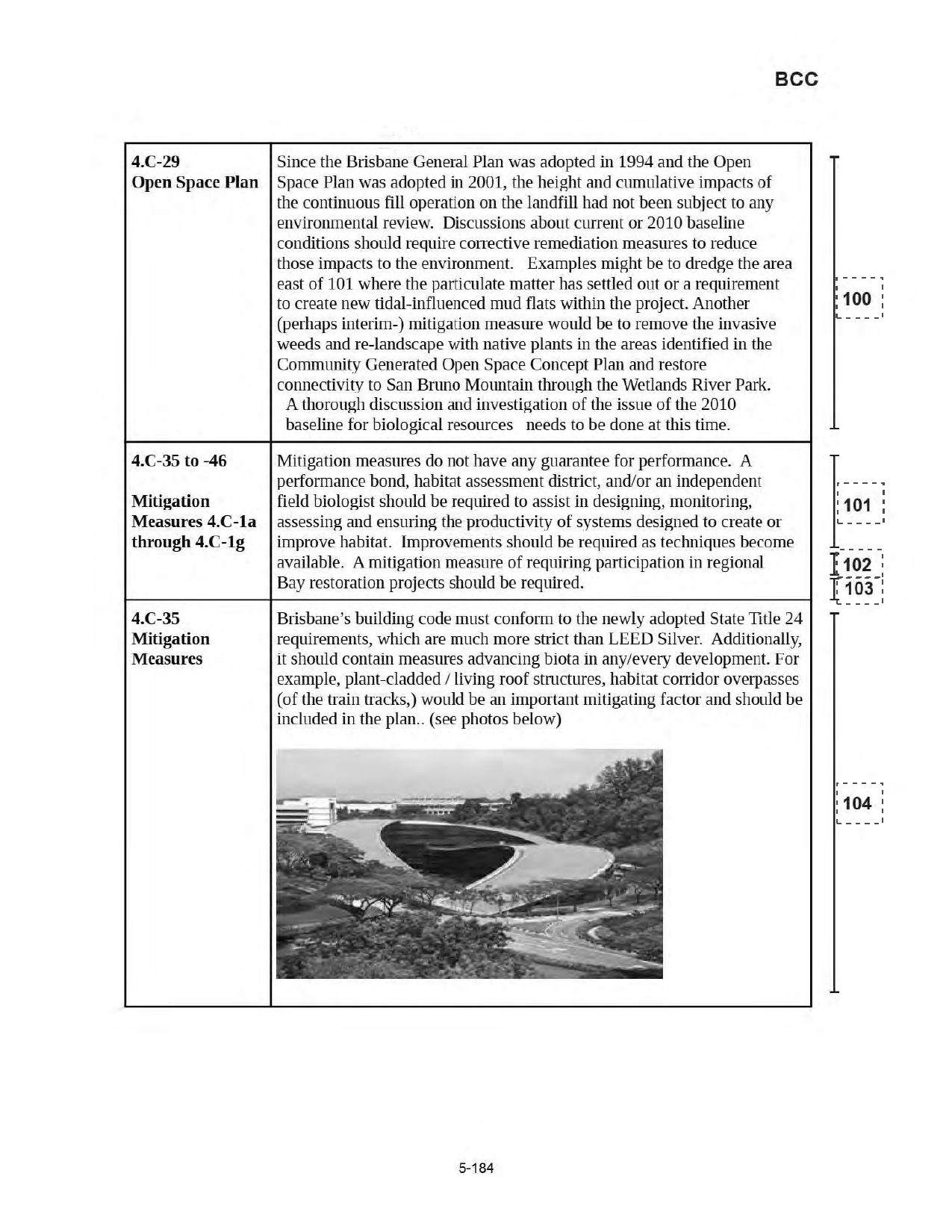
For
example,
plant-cladded
I
living
roof
structures,
habitat
corridor
overpasses
(of
the
train
tracks,)
would
be
an
important
mitigating
factor
and
should
be
included
in
the
plan
..
(see
photos
below)
4.C-35
to
-46
Mitigation
Measures
4.C-
la
through
4.C-
lg
4.C-35
Mitigation
Measures
5-184