BCC
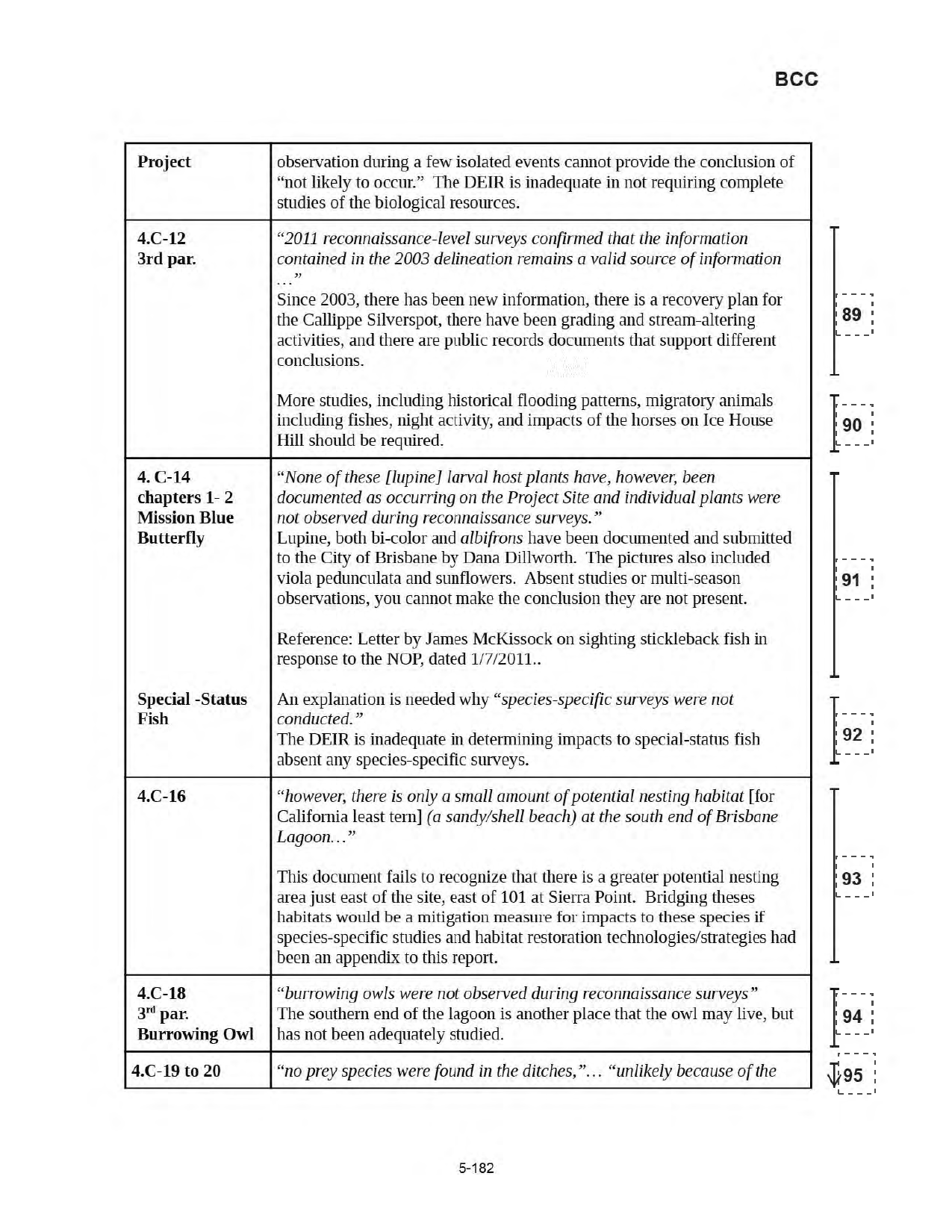
Project
observation
during
a
few
isolated
events
cannot
provide
the
conclusion
of
"not
likely
to
occur."
The
DEIR
is
inadequate
in
not
requiring
complete
studies
of
the
biological
resources.
4.C-12
3rd
par.
"2011
reconnaissance-level
surveys
confirmed
that
the
information
contained
in
the
2003
delineation
remains
a
valid
source
of
information
"
Since
2003,
there
has
been
new
information,
there
is
a
recovery
plan
for
the
Callippe
Silverspot,
there
have
been
grading
and
stream-altering
activities,
and
there
are
public
records
documents
that
support
different
conclusions.
More
studies,
including
historical
flooding
patterns,
migratory
animals
including
fishes,
night
activity,
and
impacts
of
the
horses
on
Ice
House
Hill
should
be
required.
4.
C-14
chapters
2
Mission
Blue
Butterfly
"None
of
these
[lupine]
larval
host
plants
have,
however,
been
documented
as
occurring
on
the
Project
Site
and
individual
plants
were
not
observed
during
reconnaissance
surveys."
Lupine,
both
bi-color
and
albifrons
have
been
documented
and
submitted
to
the
City
of
Brisbane
by
Dana
Dillworth.
The
pictures
also
included
viola
pedunculata
and
sunflowers.
Absent
studies
or
multi-season
observations,
you
cannot
make
the
conclusion
they
are
not
present.
Reference:
Letter
by
James
McKissock
on
sighting
stickleback
fish
in
response
to
the
NOP,
dated
117/2011..
Special
-Status
Fish
An
explanation
is
needed
why
"species-specific
surveys
were
not
conducted.
"
The
DEIR
is
inadequate
in
determining
impacts
to
special-status
fish
absent
any
species-specific
surveys.
4.C-16
"however,
there
is
only
a
small
amount
of
potential
nesting
habitat
[for
California
least
tern]
(a
sandy/shell
beach)
at
the
south
end
of
Brisbane
Lagoon
...
"
This
document
fails
to
recognize
that
there
is
a
greater
potential
nesting
area
just
east
of
the
site,
east
of
101
at
Sierra
Point.
Bridging
theses
habitats
would
be
a
mitigation
measure
for
impacts
to
these
species
if
species-specific
studies
and
habitat
restoration
technologies/strategies
had
been
an
appendix
to
this
report.
4.C-18
3n1
par.
Burrowing
Owl
4.C-19
to
20
"burrowing
owls
were
not
observed
during
reconnaissance
surveys"
The
southern
end
of
the
lagoon
is
another
place
that
the
owl
may
live,
but
has
not
been
adequately
studied.
"no
prey
species
were
found
in
the
ditches,"
...
"unlikely
because
of
the
5-182